
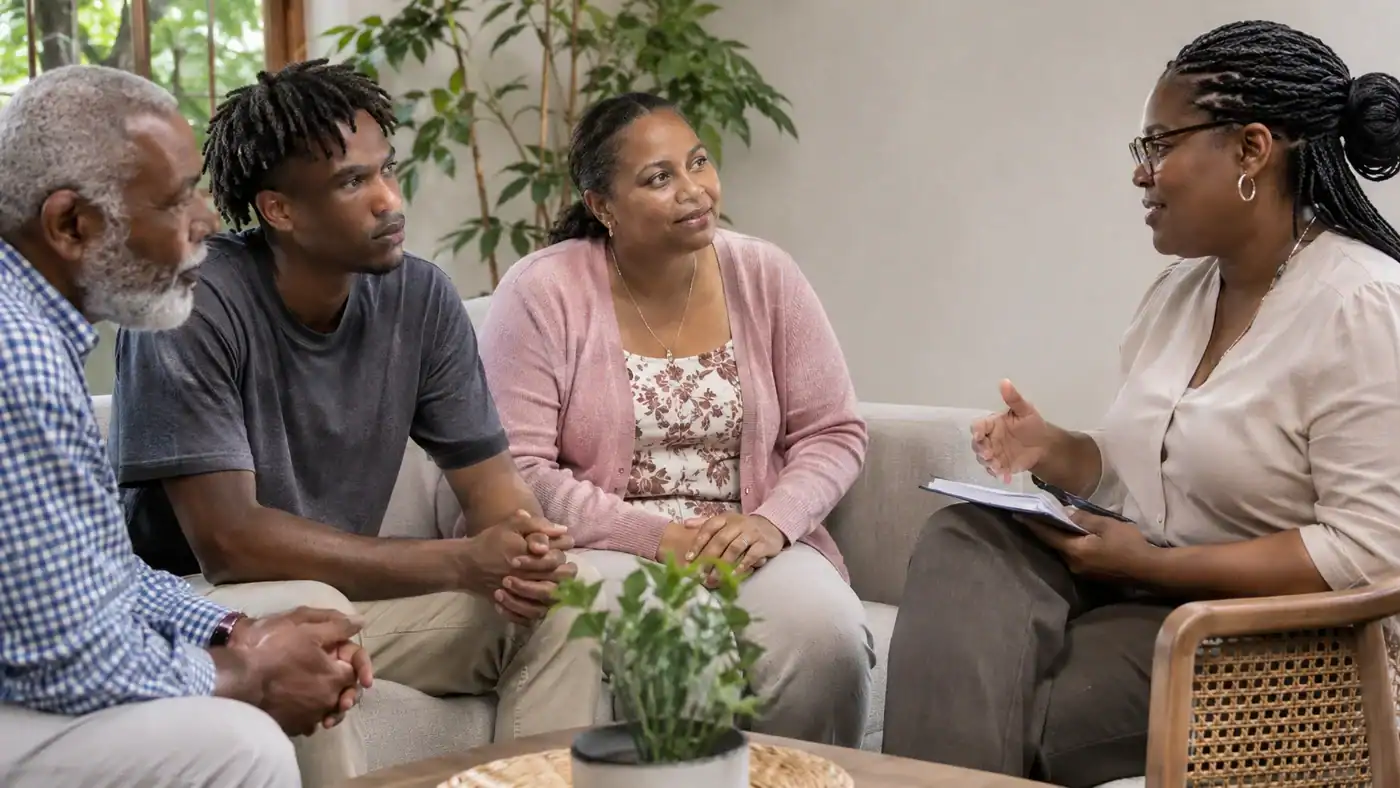
If someone in your family is in addiction, you have probably been told something like: “It is their problem. They have to want help.” This is partly true and significantly incomplete. Addiction is the person’s condition. It is also, in almost every case, a condition that has reshaped the family around it. The family does not cause addiction. But the family adapts to it, often in ways that, over years, become part of the problem.
The family disease model of addiction was developed precisely to capture this. It does not blame families. It says: this disease affects the whole household, and recovery, if it is to be durable, has to include the household.
What the Model Says
The family disease model treats addiction as a condition that affects the family system, not only the individual. The core ideas:
- Addiction does not happen in isolation. It develops, escalates, and persists within a relational and environmental context.
- Family members, over time, develop coping patterns that respond to the addiction. These patterns are protective in the short term and corrosive over the long term.
- When the addicted person enters recovery, the family system also has to change. Otherwise the system pulls the person back to the role they had occupied.
- Recovery is therefore a family process, not just an individual process.
This is not a controversial claim in the clinical world. Family-systems thinking has been a major thread in addiction treatment for decades. What is sometimes controversial is how the model is taught. Misused, it can imply families are to blame. Used well, it gives families a frame for their own healing, which is the work that no individual treatment can do for them.
Why Families Adapt the Way They Do
A family living with active addiction is dealing with chronic stress, episodic crisis, and a steady accumulation of harm. The adaptations that develop are usually the family’s best attempts to manage an unmanageable situation. Each pattern has a logic, even when, in hindsight, the pattern was not helpful.
The Compromise of Honesty
Families with a member in addiction often begin to live in a particular kind of dishonesty: with each other, with their wider network, sometimes with themselves. The lies start small (excusing an absence, covering for a missed event), and grow. Honesty is one of the early casualties.
Hyper-Vigilance
Some family members develop an exhausting attentiveness: monitoring moods, calculating substance use, anticipating crises. This is an attempt to feel in control. It rarely produces control. It does produce chronic exhaustion.
Suppression of Needs
In a household focused on the addicted member, the needs of others fade into the background. Children stop asking. Partners stop expecting. Parents stop articulating. Suppression becomes habitual, and people forget what they need.
The Roles
The classical descriptions of family roles in addiction, the enabler, the hero, the lost child, the scapegoat, the caretaker, are not pathologies. They are predictable adaptations that develop in households under sustained stress. Understanding which roles your family has fallen into is one of the most useful first steps for any family wanting to heal.
Conflict Patterns
Either constant low-grade conflict, or a particular kind of high-stakes peace where conflict is buried because it is too dangerous to express. Both patterns make honest communication very hard.
What This Means for Family Members
If you have lived with addiction in your family, you may notice some of these in yourself:
- A tendency to caretake automatically, even where it is not wanted or healthy.
- Difficulty knowing what you feel or want.
- A sense that your own wellbeing is contingent on someone else’s behaviour.
- Hyper-vigilance about emotional shifts in others.
- Difficulty trusting good times because crises have so often followed.
- Anger that does not have a clear shape.
- Guilt, often unjustified, about your role in the situation.
- A sense that you have been holding everything together for so long that you do not know who you are outside that role.
These are not character flaws. They are adaptations to chronic relational stress. They are also workable. People recover from these patterns. The first step is recognising them.
Why Family Members Need Their Own Recovery
When the person in addiction enters treatment and starts to change, the family system is shaken. The roles that have been in place no longer fit. The compensations that were necessary are no longer necessary. The dynamics start to rearrange themselves.
If the family has not done its own work, several things tend to happen:
- The system pulls the person back. Family members, often unconsciously, recreate the old patterns because they are familiar.
- New stresses emerge. The person in recovery shows up differently. Their needs are different. Their behaviour is different. The family does not know how to respond.
- The family member’s own unprocessed wounds resurface. When the immediate crisis is gone, what has been buried becomes visible.
- Trust does not rebuild on its own. Repair work requires both sides doing real work.
- Resentment, never voiced during the crisis, surfaces. Years of anger, exhaustion, and hurt do not vanish just because the substance is gone.
Family recovery addresses these. It is not optional in any serious view of addiction treatment.
What Family Recovery Looks Like in Practice
Family recovery varies from one household to another. It commonly involves the following.
Education
Learning about addiction as a condition. Understanding that it is not a moral failure, not a choice, not the result of bad parenting (in most cases), not something willpower can simply override. The educational frame changes how the family sees the situation.
Family Therapy
Structured clinical sessions with a family therapist. These address the system as a whole, the patterns that have developed, the repair work needed. Different from family information sessions, which are educational rather than therapeutic.
Mutual Aid for Families
Al-Anon, Nar-Anon, and similar fellowships are designed for family members of people with addiction. They provide community, structure, and a programme for the family’s own recovery. For many families, mutual aid is the most consistent thread of their long-term recovery.
Individual Therapy for Family Members
Where individual family members carry significant unprocessed material, individual therapy is part of the plan. This is particularly relevant for partners who have lived in addiction-affected households for years, and for adult children of addicted parents.
Boundary Work
Learning to set, communicate, and hold appropriate boundaries. Not punitive boundaries, just clear ones. This is one of the practical skills that family recovery teaches and one of the hardest to learn in real life.
Self-Care
A genuine practice of attending to one’s own needs, body, relationships, and life. Not as a luxury but as a foundation. Family members in active recovery from addiction-affected households often need to relearn this from the basics.
Time
Family recovery cannot be rushed. The patterns developed over years do not undo in months. A reasonable horizon is years of intermittent work, with continuing benefit.
What This Looks Like at Cherrywood House
Family work is part of our treatment model, not an add-on.
- Family inclusion in the assessment phase where appropriate.
- Family therapy sessions during the residential phase, with a trained family therapist, with the consent of the person in treatment.
- Family information sessions that build understanding of addiction and the family disease frame.
- Family inclusion in aftercare, including dedicated family support and groups.
- Recommendations for individual family therapy and mutual aid where these are appropriate alongside our own programme.
We are clear with families that the work is theirs to do, and we resource them to do it. We do not, however, do the work for them. That is a clinical principle, not a limitation.
What Family Recovery Is Not
Family recovery is sometimes misunderstood. These distinctions help clarify the model.
- It is not blaming the family. Addiction is the addicted person’s condition. The family is responding, not causing.
- It is not making the family responsible for the person’s recovery. That responsibility remains with the person in addiction.
- It is not group therapy where the family takes turns confessing. It is structured work on the system, with consent and care.
- It is not a quick path. Real family recovery takes longer than the residential phase.
- It does not require the addicted person to be in recovery. Family recovery can begin even when the person in addiction is not yet willing to engage. The family’s own healing does not require the addicted person’s cooperation.
When to Start
The right time to start family recovery is now. If your loved one is in active addiction, family recovery begins by getting your own support: education, therapy, mutual aid, conversation with a professional. You do not have to wait until they are willing to engage.
If your loved one is entering or in treatment, family recovery becomes part of the wider treatment plan. The earlier the family participates, the better the outcomes.
If your loved one is in long-term recovery and the family is still struggling, family recovery is still indicated. Many families come to formal family work years after the addiction has been treated, because the relational damage is real and persistent.
FAQ: The Family Disease Model
Did our family cause the addiction?
No, in almost all cases. Addiction has many contributing factors and is not caused by family dynamics. What family dynamics can do is contribute to the maintenance of the addiction over time, and certainly affect recovery.
My loved one does not want help. Should I still go to Al-Anon or therapy?
Yes. Your recovery does not depend on their willingness. In many cases, your changes are part of what eventually shifts their willingness.
Are family members really sick?
“Sick” is a strong word. What is accurate is that family members in addiction-affected households often develop patterns that are unhealthy for them. These patterns are treatable.
Does Cherrywood House include family work in the programme?
Yes. Family therapy and family inclusion are part of our treatment model where appropriate.
Can children attend family sessions?
Children’s involvement is decided clinically and with care. Older adolescents may be involved in some sessions. Young children are usually supported separately, with their developmental needs in mind.
Is the family disease model the same as codependency?
Codependency is one specific concept that emerged from family disease thinking. The family disease model is broader. Both have their place; both can be misused if applied as labels rather than as frameworks for understanding.
If addiction has been part of your family life, your own recovery matters too. Call Cherrywood House on +27 79 714 1966 or email info@cherrywoodhouse.com to discuss family-inclusive treatment and resources.
Related Cherrywood House support
Need confidential, professional support? Speak with Cherrywood House about the right next step.

